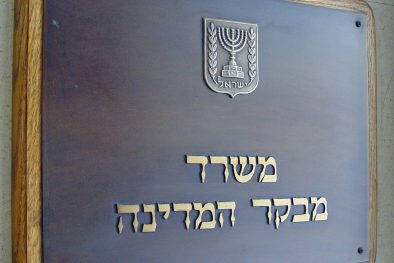
Israel Without a State Comptroller: The Legal Consequences of the Annull...
In June 2026, Israel's High Court of Justice annulled the Knesset vote in which Adv. Michael Rabello was…
Read More


An interview with Adv. Maxim Rakov
In the final week of its term, the Knesset passed a package of laws, among them a law temporarily halting the arrest of ultra-Orthodox draft evaders. The Legal Advisor to the Knesset, Sagit Afek, has submitted an opinion to the High Court of Justice pointing to serious procedural violations in the way the law was enacted. Petitions to strike down the law are being heard by an expanded panel of nine justices.
In a recent radio interview, the legal aspects of the situation were analyzed by our partner, Adv. Maxim Rakov, Head of the International Department at our firm, formerly Deputy General Counsel at the Prime Minister’s Office and Legal Advisor to Israel’s National Security Council.
What is the legal basis for the objections raised by the Knesset Legal Advisor, Sagit Afek, to this law?
There are two principal grounds: one substantive and one procedural.
Let us start with the procedural one.
The law originated in a bill that had passed its first reading in the previous Knesset: it was submitted as a government bill back in 2022. Under the Basic Law: The Knesset and the Knesset Rules of Procedure, the general rule is that if a Knesset term ends before a bill completes the legislative process, the bill lapses and cannot be carried forward.
Unless the continuity rule, the din retsifut, applies?
Correct. The continuity rule (din retsifut) allows the legislative process to continue from one Knesset term to the next. Two conditions must be met: the bill must have passed at least its first reading, and the Knesset must vote to continue the process. Both conditions were satisfied here. However, when a bill proceeds under the continuity rule, no substantially new matters may be added to it. In this case, the original bill dealt with how to ensure that yeshiva students serve in the military. It was turned into a bill about how to ensure that they do not serve and are not penalized for it. That is a substantial change, which the continuity rule does not permit. Accordingly, the law was enacted in violation of procedure.
Why did Sagit Afek raise this now, rather than before the vote or during the deliberations?
First, these objections were raised throughout: they were voiced repeatedly during the process. Why now: because a petition to strike down the law is now before the Supreme Court. Under the Court’s established practice and precedent, a law is reviewed once it has been enacted. The Court does not intervene in preliminary proceedings inside the Knesset: this reflects mutual respect between the two branches of government. The logic is simple: we do not interfere with what you are doing, we will examine what you have done. This is therefore precisely the moment for submitting a position.
As to how the situation arose: the coalition wanted to save time. It did not want to submit a government bill on this issue, because that would have required coordination within the executive branch: with the Ministry of Justice, with the Attorney General, who opposed the measure, and with the military, which opposed it as well. Instead, a shortcut was chosen: take an existing bill and attach the new content to it. This is not the first time the coalition has acted this way, and it is unprofessional. They expected it to pass unchallenged: it did not.
And what is the second, substantive ground?
On the merits, the law violates the principle of equality before the law, that is, the Basic Laws and the precedents of the Supreme Court. In addition, since October 7 the country has been at war, the military is under very significant strain and is short of personnel. Instead of helping the military, the law operates in exactly the opposite direction. The required balance has not been maintained.
Does the High Court of Justice examine the substance of a law, or only the process of its enactment?
I believe that in this situation it will be easy for the Court to strike down the law on procedural grounds. We have seen the High Court intervene on the merits as well, but that is a matter of each justice’s judicial philosophy. Here, annulment on procedural grounds is far more straightforward than in many other cases: the law states outright that some are to be arrested and others are not, and the distinction tracks support for the coalition. Still, it will be convenient for the Court to confine itself to the procedural violation: there is no need to reach the merits at all if the law can be struck down for procedural defects alone. The Court is entitled not to rely on every available ground for annulment. The division of roles is telling: the Knesset Legal Advisor emphasizes procedure, which is her area of authority, while the Attorney General emphasized the merits and the public interest.
The opposition says: once in power, we will repeal everything. Could a new coalition, figuratively speaking, undo its predecessors’ laws in a couple of nights?
It must be done within the proper procedure. A government bill first requires the full coordination process within the executive branch, followed by three readings. A private member’s bill must first pass a preliminary reading and then be prepared for the first, second and third readings. A bill repealing an existing law follows the same path as any other bill: three or four readings, depending on whether it is a government or a private bill. It cannot be done in two nights. Can it be done quickly? Yes, it can.
So a law passed by the Knesset has no protection against repeal by the next Knesset?
There are certain provisions of the Basic Laws, and, as far as I recall, one or two ordinary laws, that can be amended only by a qualified majority of the Knesset: for example, 61 or 80 votes. If a provision is not entrenched, it can be amended by the ordinary procedure. An interesting detail: the majority set to entrench a provision is not necessarily the same majority required to repeal it. As for the package just enacted, only one of these laws is a Basic Law: the Basic Law on Torah Study. The rest are ordinary laws, and they can be repealed through the ordinary legislative process.
And how can the Basic Law on Torah Study be repealed?
It, too, can be repealed, because it is not entrenched. Israel has no constitution and no Basic Law: Legislation, which there have been repeated attempts to enact. Consequently, no special constitutional procedure exists for repealing Basic Laws: they are repealed in the same way as ordinary laws.
Adv. Maxim Rakov is a partner and Head of the International Department at Elbert Nazaretsky Rakov & Co. He previously served as Deputy General Counsel at the Prime Minister’s Office and as Legal Advisor to Israel’s National Security Council. Admitted to practice in Israel and New York, he specializes in international banking regulation, compliance, sanctions law and cross-border corporate structures, with over 25 years of professional experience.
This material is provided for informational purposes only and does not constitute legal advice.
enr-law.com | [email protected] | +972 (9) 88 11 755